Enterprise AI Knowledge Management Systems: Private RAG for Manufacturing, Healthcare, Museums & Government
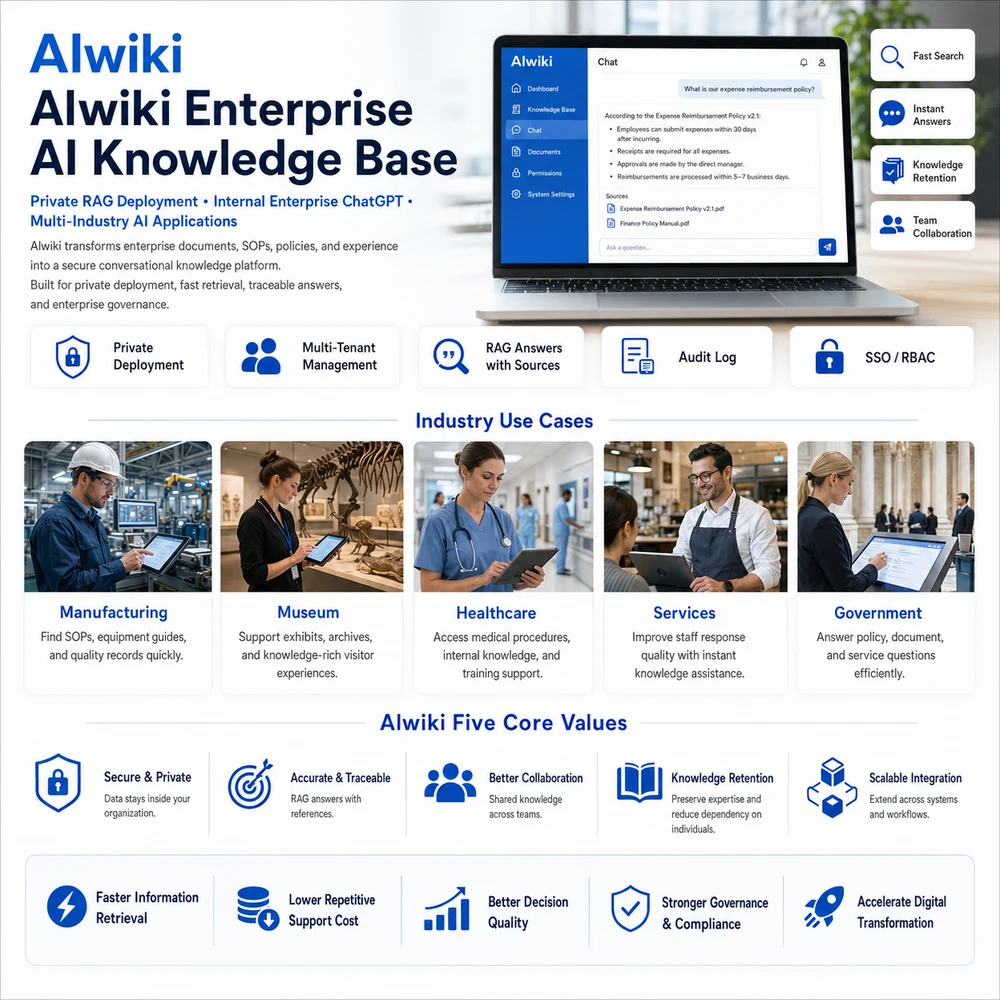
AIwiki is an enterprise-grade AI Knowledge Management System and zero-hallucination Private RAG Knowledge Base platform engineered for manufacturing plants, healthcare institutions, cultural museums, service enterprises, and government agencieshttps://voca168.com/ .
Organizations continuously accumulate vast troves of unstructured data: standard operating procedures (SOPs), technical manuals, compliance regulations, official memos, training guides, customer support logs, historical case files, and senior staff expertise. However, more documentation rarely equals accessible knowledge. Critical assets often remain trapped across isolated local PCs, cloud drives, legacy databases, emails, and department folders. When employees need to verify a policy, machine error code, product spec, or historical legal precedent, they lose valuable time searching disconnected systems or relying on key personnel memory.
AIwiki transforms fragmented corporate knowledge into an instantly searchable, conversational, auditable, and secure digital asset. Powered by Retrieval-Augmented Generation (RAG), AIwiki queries authorized organizational repositories first, generating precise answers backed by exact source citations, document versions, and paragraph references.
What is an Enterprise RAG Knowledge Base?
Retrieval-Augmented Generation (RAG) solves the fundamental limitation of standard public LLMs. While public models rely solely on static training data—unaware of internal corporate workflows, proprietary machinery specs, recent compliance updates, or confidential contracts—AIwiki retrieves authorized internal documentation before synthesizing answers.
Everyday Employee Inquiries Handled by AIwiki:
-
Manufacturing: “What is the troubleshooting procedure when Equipment A displays Error Code E-402?”
-
HR & Administration: “What are the latest corporate guidelines for parental leave, overtime, and business travel expense reimbursement?”
-
Government Agencies: “What specific legal conditions apply to Public Memo Policy #108?”
-
Museums & Venues: “What is the historical background, era, and creation history of Exhibit Artifact #45?”
-
Service Sector: “What is the step-by-step procedure for processing customer product exchanges?”
-
Healthcare Institutions: “Which document specifies internal nursing protocols and infection control guidelines?”
AIwiki delivers precise answers grounded in authorized enterprise data, displaying exact source links so users can open original files to verify details.

Zero Hallucinations: Grounded Answers with Precise Paragraph Citations
When enterprises adopt Generative AI, data accuracy and reliability are paramount. AIwiki eliminates hallucination risks by embedding full source attribution into every response.
Every AI Answer Displays:
-
Source Document Title and exact cited paragraphs
-
Document Version Control and last update timestamps
-
Knowledge Repository Origin and confidence state score
-
Human Verification Prompts when internal data is insufficient
If the repository lacks adequate information, the system refuses to guess—flagging the data gap, recommending human agent escalation, or creating a support ticket.
Air-Gapped On-Premise LLM & Internal ChatGPT Deployment
For enterprises, healthcare systems, and government bodies bound by strict data sovereignty regulations, AIwiki supports fully Air-Gapped Private AI architecture.
Flexible Infrastructure Deployments:
-
On-Premise Data Centers (Self-Hosted Servers)
-
Isolated Government & Healthcare Intranets
-
Private Cloud & Air-Gapped Environments
-
Hybrid Cloud Architecture
Powered by On-Premise LLM servers, all vector databases, language models, document indices, employee queries, and audit trails remain strictly within the organization’s firewall. Employees gain access to a Private Internal ChatGPT that complies fully with existing corporate cybersecurity policies, eliminating data leakage to public clouds.
Enterprise Access Governance: SSO, RBAC & Audit Logging
Corporate knowledge access must be strictly governed based on organizational roles. AIwiki integrates Single Sign-On (SSO) and Role-Based Access Control (RBAC) to enforce granular permissions:
-
Manufacturing Teams: Access equipment manuals, safety SOPs, and process parameters.
-
Quality Assurance (QA): Access ISO guidelines, quality specs, and defect logs.
-
Human Resources (HR): Query personnel policies, benefits, and onboarding workflows.
-
Healthcare Staff: Access authorized clinical admin guidelines and hospital SOPs.
-
Government Personnel: Query restricted departmental memos and case histories.
-
External Partners: Restricted strictly to designated partner knowledge bases.
Administrators maintain complete control over document publishing, updates, and archival. Immutable Audit Logs record user logins, search queries, document modifications, and permission shifts—ensuring total compliance and auditability.
Industry-Specific Applications
1. Smart Manufacturing & Industrial AI Knowledge Base
Manufacturing plants accumulate equipment manuals, production SOPs, quality specifications, maintenance logs, ISO records, engineering drawings, and veteran technician notes.
-
Key Benefits: Reduces time spent searching PDF manuals, mitigates knowledge loss from retiring engineers, accelerates new worker onboarding, and unifies maintenance logs across factory sites.
-
Integrations: Connects seamlessly with ERP, MES, and work-order platforms.
2. Museums, Cultural Venues & Digital Archives
Museums and galleries manage extensive curatorial research, artifact provenance, exhibit documentation, and educational materials.
-
Key Benefits: Powers interactive AI Tour Guides via QR Codes, tablets, or touchscreens; delivers verified multilingual responses; and prevents accurate cultural data from being diluted by web hallucinations.
3. Healthcare Institutions & Medical SOP Search
Hospitals and clinics govern administrative policies, nursing SOPs, infection control rules, medical equipment operating guides, and compliance files.
-
Key Benefits: Speeds up hospital policy verification, ensures strict role-based data protection, and maintains audit trails. (Note: AIwiki serves as an administrative and educational tool, not for clinical diagnosis or medical treatment decisions.)
4. Service Enterprises, Retail & Customer Support Co-Pilot
Retail chains, hospitality brands, and service centers require consistent staff knowledge across multiple branches.
-
Key Benefits: Unifies product FAQs, return rules, and store SOPs; equips staff with an instant internal copilot; and powers external website AI chatbots with seamless human escalation.
5. Government Agencies & Smart Public Memos
Public institutions process massive volumes of official correspondence, administrative rules, legal interpretations, and historical public cases.
-
Key Benefits: Speeds up policy retrieval for civil servants, reduces redundant cross-department requests, preserves institutional memory, and operates inside secure air-gapped government intranets.
Solving the 5 Core Knowledge Management Bottlenecks
-
Slow Onboarding Timelines: New hires instantly query internal SOPs and products without repeatedly interrupting senior mentors.
-
Loss of Senior Expertise: Senior engineer notes, maintenance logs, and field knowledge are converted into searchable digital assets before retirement.
-
Fragmented Cross-Department Data: Teams access verified information through a unified interface with RBAC security.
-
Internal Helpdesk Overload: IT, HR, and administrative helpdesks automate routine FAQs, freeing human staff for complex tasks.
-
Outdated Document Versioning: Centralized lifecycle management ensures documents are reviewed, updated, and archived systematically.

AILocallm3

Why Choose AIwiki Enterprise AI Knowledge Base?
-
Grounded in Verified Data: Answers feature clear paragraph citations and version controls.
-
Total Cybersecurity: Supports air-gapped on-premise LLMs, private intranets, and multi-tenant isolation.
-
Maintainable Lifecycle: Features document approval, publishing, and expiration workflows.
-
Complete Auditability: Built-in Audit Logging tracks every query, login, and permission change.
-
Scalable API Integrations: Connects with corporate ERP, MES, CRM, HR, and ticketing platforms.
Frequently Asked Questions (FAQ)
What is an Enterprise AI Knowledge Base?
An Enterprise AI Knowledge Base integrates internal documents, SOPs, contracts, and case files into a conversational platform, allowing employees to query information using natural language.
How does AIwiki differ from public ChatGPT?
AIwiki answers exclusively based on your organization’s authorized internal files, provides paragraph citations, and supports air-gapped on-premise deployment, RBAC permissions, and complete audit logging.
Can AIwiki be deployed entirely on a private internal network?
Yes. It can be deployed via On-Premise LLM servers, private cloud, or air-gapped intranets, ensuring sensitive corporate data never leaves your infrastructure.
What document formats are supported?
AIwiki ingests PDFs, Word documents, Excel sheets, PowerPoint presentations, web pages, plain text files, FAQs, SOPs, and structured corporate documentation.
Does AIwiki cite data sources in its answers?
Yes. Every response displays cited document names, paragraph excerpts, version numbers, and repository locations for verification.
Can different departments be restricted to specific documents?
Yes. SSO and RBAC authentication enforce multi-tenant isolation, ensuring marketing, HR, engineering, and legal teams access only their designated repositories.
Can it integrate with ERP, MES, or CRM systems?
Yes. AIwiki connects to third-party enterprise platforms via RESTful APIs and Webhooks based on authorized system credentials.
Does AIwiki replace medical clinical decision-making?
No. AIwiki functions strictly as an administrative, policy search, and educational tool for healthcare personnel, not for clinical diagnosis or medical judgment.
Can government agencies deploy AIwiki locally?
Yes. AIwiki complies with strict government data security standards, offering local air-gapped deployment with complete RBAC and immutable audit logging.
Build a Secure, Auditable, and Scalable AI Knowledge Repository for Your Enterprise Today!